

From Code to Scalable System: Lessons from My First Microservices Project
In this post, I’ll share the biggest lessons I learned while moving from “just writing code” to building a scalable system.
MICROSERVICESSYSTEM DESIGNMONOLITH VS MICROSERVICESDISTRIBUTED SYSTEMS
Anthony
9/16/20252 min read
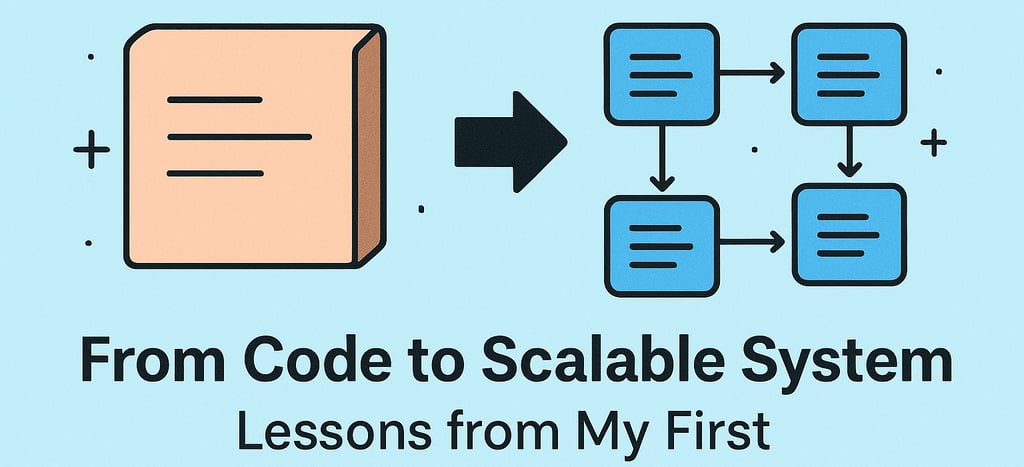
From Code to Scalable System: Lessons from My First Microservices Project
When I first started working as a backend engineer, I was comfortable with Java, Spring Boot, and building APIs. But when I got my first real microservices project, things felt very different. It wasn’t just about writing clean code anymore—it was about designing systems that could scale, survive failures, and still remain simple enough for the team to maintain.
Looking back, that project shaped how I think about engineering today. In this post, I’ll share the biggest lessons I learned while moving from “just writing code” to building a scalable system.
1. Breaking the Monolith is Harder Than It Sounds
At first, the idea of microservices felt exciting. Small, independent services—how hard could it be? But when we actually split the monolith:
Database boundaries became tricky (not everything should share one DB).
Data consistency turned into a daily debate.
Suddenly, we needed to handle service discovery, API contracts, and versioning.
👉 Lesson: Don’t split for the sake of splitting. Start with a clear reason—scalability, team ownership, or performance bottlenecks. Otherwise, you’ll just end up with a distributed mess.
2. Communication Between Services is Everything
We started with REST APIs between services. It worked, but soon latency and cascading failures showed up. Adding retries and circuit breakers became critical. Later, we explored event-driven patterns (Kafka) for async communication.
👉 Lesson: Think about how services will talk on Day 1. Sometimes REST is fine, but if the business flow is heavily event-based, designing with a message broker in mind saves pain later.
3. Monitoring and Logging Aren’t “Nice-to-Haves”
During the early days, when something broke, we were literally blind. Logs scattered across services, no tracing, no dashboards. Debugging one user issue meant chasing multiple services manually.
Once we added centralized logging (ELK stack) + distributed tracing (Zipkin/Jaeger), the difference was night and day. Suddenly, we could see end-to-end requests across services.
👉 Lesson: Build observability early. Without it, you’ll waste more time firefighting than building.
4. Resilience > Perfection
In a monolith, if something crashes, you restart it and move on. In microservices, one failure can ripple across the system. We learned the importance of:
Timeouts and retries (with backoff).
Circuit breakers (stop calling a broken service).
Graceful degradation (still serve something useful even if a part is down).
👉 Lesson: Design for failure. Assume services will go down, and make sure the system can still breathe.
5. The Human Side of Microservices
This part surprised me the most. Microservices are as much about teams as they are about tech. Splitting services only works if teams can own them end-to-end. If everyone touches everything, you’re back in monolith-land—just with more pain.
👉 Lesson: Align services with team ownership. Tech decisions without people alignment = chaos.
Final Thoughts
That first project was messy, full of late-night debugging, and taught me lessons the hard way. But it also gave me the confidence to design systems beyond just “working code.”
If you’re starting your first microservices project, remember:
Keep it simple.
Design for communication, observability, and resilience.
And most importantly—build systems for people, not just for code.
Because at the end of the day, scaling isn’t just about handling more requests—it’s about enabling teams to deliver value without burning out.
💡 This post is part of my engineering journey at Built by Anthony. If you’re a developer figuring out microservices, I’d love to hear your stories—what lessons did you learn from your first project? Write me at builtbyanthonyofficial@gmail.com
Insights
Explore coding techniques and problem-solving strategies here.
Resources
Support
© 2025. All rights reserved.