

The Hidden Costs of Bad Code Reviews | BuiltByAnthony
Discover the real impact of poor code reviews — from wasted time to team burnout. Learn how to build a healthy, high-trust review culture.
ENGINEERING CULTUREBACKEND DEVELOPMENTTEAM LEADERSHIP
Anthony J
10/31/20252 min read
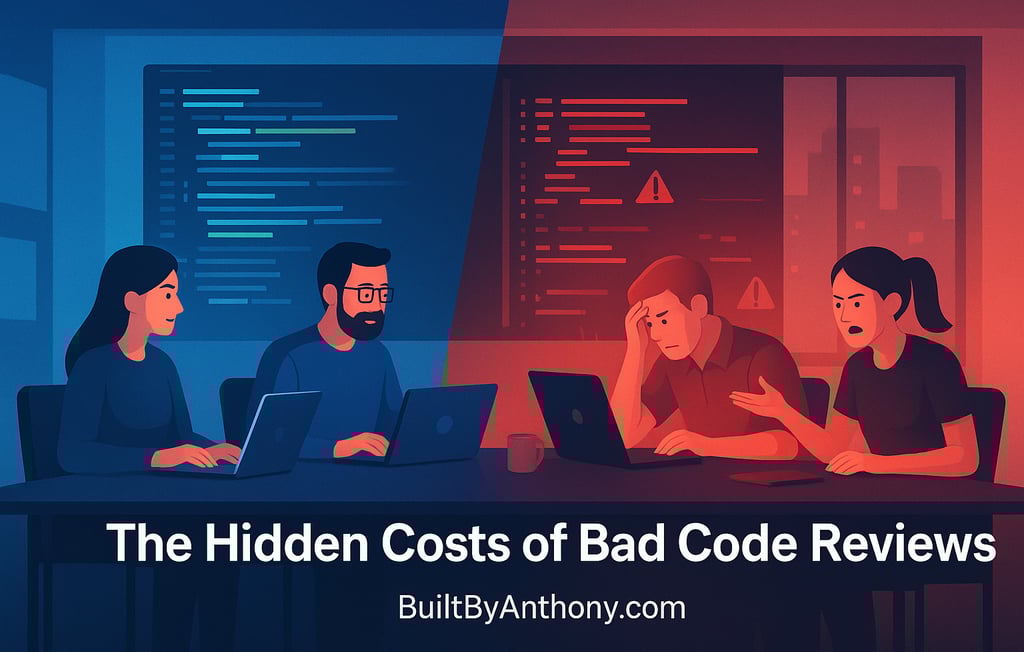
The Hidden Costs of Bad Code Reviews
(And How They Quietly Kill Productivity, Culture & Quality)
If you’ve ever worked in a team where code reviews felt like a checkbox, you’ve likely seen the slow damage.
At first, it’s subtle a few delays here, a few passive comments there but soon, it snowballs into missed deadlines, frustration, and technical debt.
Code reviews are meant to make software better.
But when done wrong, they silently drain your team’s energy, creativity, and trust.
Let’s uncover what really happens when code reviews go bad and how to fix it before it’s too late.
1. The Cost of Wasted Time
When reviews take days to complete, or get lost in endless nitpicking, developers lose momentum.
Every delay breaks focus and context switching kills deep work.
In most cases, slow reviews do more harm than bugs themselves.
Fix:
Define review SLAs (e.g., feedback within 24 hours) and use automated linting tools to handle style issues so humans can focus on logic and design.
2. The Cost of Lost Motivation
Code reviews are emotional.
A harsh tone, unclear feedback, or a “just fix it” comment can make developers feel attacked, not guided.
When that happens, they stop engaging they’ll do the minimum just to avoid the pain.
Fix:
Lead with empathy.
Say “Let’s improve this part because…” instead of “This is wrong.”
Remember: the goal is growth, not ego.
3. The Cost of Poor Knowledge Sharing
A healthy review process spreads wisdom.
A broken one keeps it siloed.
If only senior devs review or feedback lacks explanation, juniors stay stuck repeating the same mistakes.
When those seniors move on, the team loses its knowledge base.
Fix:
Rotate reviewers and encourage “why” explanations.
Use reviews as micro-mentorship moments, not gatekeeping sessions.
4. The Cost of Technical Debt
Every ignored review comment or “temporary fix” is a small loan from your future self.
Soon, you’re paying interest in refactors, bugs, and regressions.
Bad reviews don’t just let bugs slip they let bad patterns become habits.
Fix:
Look beyond the diff.
Ask: “Is this scalable? Will it make sense to someone new?”
Because today’s shortcuts are tomorrow’s outages.
5. The Cost of Trust Erosion
When code reviews become political where approvals depend on who you are, not what you wrote trust dies fast.
Developers start bypassing reviews, hiding commits, or avoiding collaboration altogether.
And once trust breaks, no amount of Jira tickets can fix your velocity.
Fix:
Document your review standards.
Encourage open discussions and acknowledge good reviews publicly.
Fairness builds trust silence destroys it.
Final Thoughts
Code reviews are more than just a gate for code they’re a mirror for culture.
Good reviews teach, inspire, and uplift.
Bad ones chip away at motivation, teamwork, and product quality.
In the long run, bad code reviews cost more than bad code because they rot the system from the inside.
Key Takeaway
Every PR you open or review is an opportunity not just to improve code, but to build better engineers and better teams.
So the next time you hit “Review Changes,” ask yourself —
👉 Am I fixing code, or am I growing people?
I write about engineering culture, system design, and lessons from real-world tech journeys at BuiltByAnthony.com, feel free to write me at builtbyanthonyofficial@gmail.com.
Insights
Explore coding techniques and problem-solving strategies here.
Resources
Support
© 2025. All rights reserved.